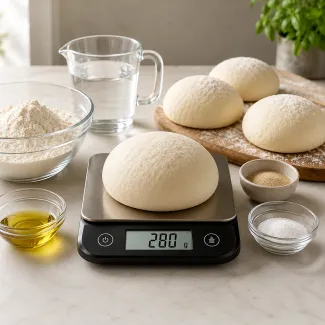
Calculate pizza dough quantities before you mix
Pizza dough looks simple until one small number ruins the whole batch: too much water and the dough sticks like glue, too little and the crust bakes dense and dry. This pizza dough calculator solves that before flour even touches the bowl.
Enter the number of pizzas, dough ball weight, hydration, salt percentage, yeast percentage and oil if your style uses it. The calculator gives you calculated gram weights for flour, water, salt, yeast and optional oil, so you can scale the dough accurately without guessing by cups or spoons.
This is especially useful when you move from one pizza to six, change from thin pizza to a softer crust, or want consistent results across different baking days. For shaping and baking technique, pair the calculation with Italian pizza dough or the Neapolitan pizza recipe. The calculator gives you the dough formula; the final texture still comes from flour strength, resting time and how the dough feels under your hands.
Pizza dough without guesswork
Calculate flour, water, salt, oil, yeast or sourdough starter, dough ball weight, sauce, cheese, baker’s percentages and a preparation schedule. The calculator factors in pizza style, shape, fermentation temperature, flour type and dough reserve.
Basic settings
Units
Shape
Calculation mode
Dough formula
Advanced topping and schedule settings
Dough
| Ingredient | Amount |
|---|---|
| Flour to add | 624 g |
| Water to add | 393 g |
| Total flour in dough | 624 g |
| Total water in dough | 393 g |
| Salt | 15.6 g |
| Oil | 9.4 g |
| Fresh yeast | 1.7 g |
Baker’s percentages
| Ingredient | Percentage |
|---|---|
| Flour | 100 % |
| Water | 63 % |
| Salt | 2.5 % |
| Oil | 1.5 % |
| Yeast | 0.28 % |
Topping
| Ingredient | Amount |
|---|---|
| Tomato sauce | 320 g |
| Mozzarella / cheese | 360 g |
| Finishing olive oil | 20 g |
The dough is suitable for cold fermentation: less yeast, better aroma and easier stretching.
Chef PEKIS – professional chef and recipe developer with over 25 years of hands-on experience. I refine classic techniques into reliable, repeatable results for the home kitchen.
The pizza dough calculator logic is reviewed from a practical baker’s perspective: flour is treated as the base, and water, salt, yeast and oil are calculated from it using baker’s percentage. That makes the method reliable for scaling because the dough formula stays proportional, while the final feel still depends on flour strength, room temperature and fermentation time.
The most important number in this calculator is hydration. Higher hydration gives a softer, airier dough, but it also needs stronger handling, more bench flour control and enough resting time. Lower hydration is easier to shape, yet it can bake firmer if the dough is not rested properly. For most home pizza, the calculator result should be weighed in grams, not rounded by volume.
Dough ball weight controls the final pizza size and thickness. A light dough ball gives a thinner base; a heavier one gives more chew and a fuller edge. Salt affects flavor and gluten strength, so do not remove it casually. Yeast controls fermentation speed, but room temperature and resting time still matter. More yeast is not always better; it can push the dough too fast and leave a flat, yeasty flavor.
Use the calculator as a precise formula starting point, not as a replacement for the dough signal. If the dough feels tight, rest it before forcing the shape. If it spreads too much, reduce hydration next time, use stronger flour or shorten the warm fermentation.
When converting between grams, cups or tablespoons, use the kitchen measurement conversion calculator, because small measuring errors quickly change hydration, salt level and dough handling.
Calculators