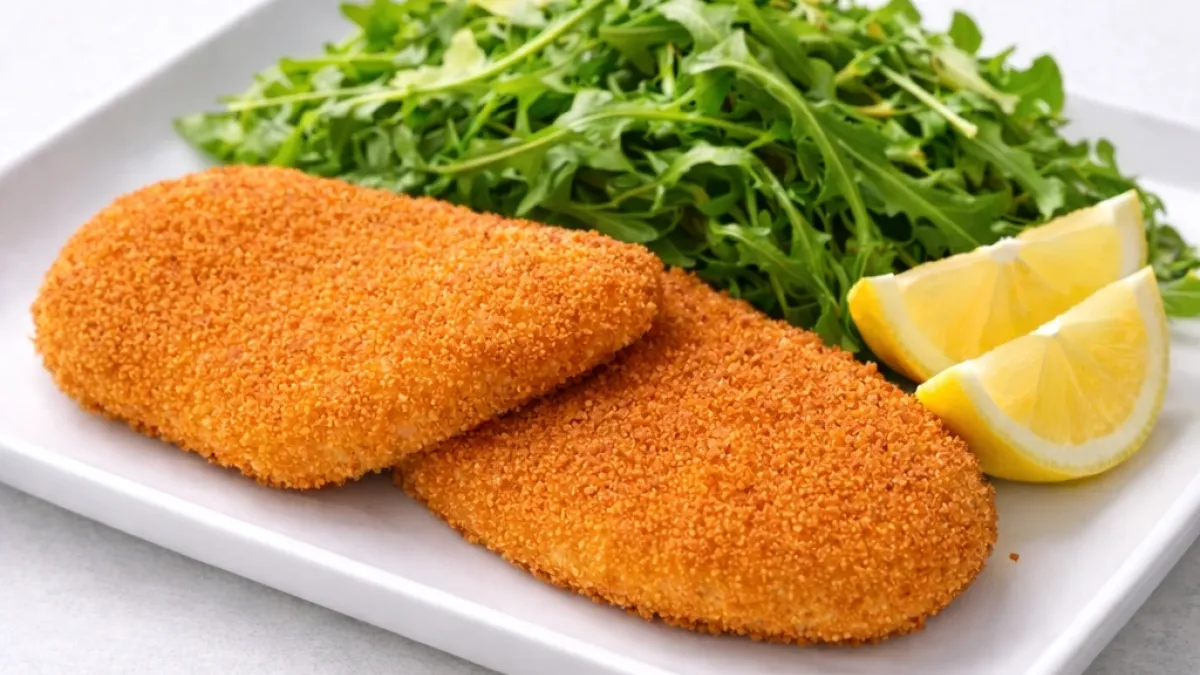
A thin golden crust gives way to tender chicken, releasing a brief burst of steam before lemon sharpens the air and fresh arugula lifts the plate. In Crispy Chicken Milanese with Lemon Arugula Lunch Plate, contrast defines every bite: crisp against juicy, warmth against peppery greens. Served at midday, it feels balanced, structured, and clean rather than heavy, leaving the palate refreshed rather than weighed down.
Precision, Heat and Contrast in a Milanese Lunch Plate
Crisp Structure, Controlled Acidity and Fresh Lift
A properly made Crispy Chicken Milanese with Lemon Arugula Lunch Plate announces itself the moment the knife breaks the crust. There is a dry crack, not a dull thud. Steam rises briefly, then disappears. The surface remains intact. That moment defines whether the structure has been respected.
This plate is not about frying. It is about control.
The Structural Mechanism
Three elements carry the dish:
- A thin, evenly pounded cutlet
- A compact layer of fine breadcrumbs
- A sharp, clean finish of lemon and raw arugula
The chicken must be uniform in thickness. If one side is thicker, heat travels unevenly, the crust darkens too quickly, and moisture escapes from the thinner edge. Precision at this stage prevents every downstream flaw.
The breadcrumb layer must be tight, not fluffy. Fine crumbs create a sealed surface that browns evenly and holds structure. Coarse crumbs fracture more easily and absorb excess oil.
Oil temperature is the governing force. At 170–175°C (340–350°F), the exterior sets immediately. Below that, the coating absorbs fat. Above that, the crust darkens before the interior cooks through. The logic mirrors the principles behind searing meat correctly, even though here the crust is built rather than directly formed on bare protein.
Texture: Practical Quality Signals
A correct Milanese cutlet shows:
- Even golden color with slightly deeper edges
- No bubbling pockets under the crust
- Dry surface after resting on a rack
- Clean cut line without crumbling
If crumbs detach when sliced, the meat surface was damp before flouring. If the crust softens within minutes, oil temperature was unstable or draining was inadequate.
The interior must remain moist but not wet. Fibrous texture signals overcooking. Pale center signals insufficient heat penetration.
Flavor Hierarchy
Acidity leads. Lemon is applied after frying, never during. Contact with a hot crust releases aroma without saturating the coating.
Arugula introduces:
- Peppery bitterness
- Fresh moisture contrast
- Visual lift and height
The greens must be lightly coated in oil, not glossy. Overdressed leaves collapse and flatten the structure of the plate.
Compared to heavier pairings such as potato salad, seen in plates like Crispy Pork Schnitzel with Classic Potato Salad, this Milanese composition remains lighter and more direct. It is defined by brightness rather than density.
What This Version Avoids
This plate deliberately excludes:
- Thick chicken breasts
- Melted cheese layers
- Tomato-based toppings
- Cream sauces
Those additions shift the identity away from Milanese toward other regional interpretations. Here, restraint preserves clarity.
Service Control
For correct presentation:
- Cutlets are placed flat, never stacked
- Arugula is centered, not scattered
- Lemon wedges remain accessible but secondary
- The plate surface stays clean
Stacking traps steam and softens the crust within minutes. This is one of the most common professional errors during service.
Limitations of the Dish
Crispy Chicken Milanese performs best:
- Immediately after frying
- In small, controlled batches
- As a lunch or early dinner plate
It is not suited to prolonged holding. Steam tables and covered trays compromise crust integrity. The structure depends on dryness.
Storage and Reheating Logic
If storage is necessary:
- Cool completely on a rack
- Avoid airtight sealing while still warm
- Refrigerate in a single layer
Reheat in a dry oven to restore surface crispness. Microwave reheating softens the crust irreversibly.
Arugula must always be prepared fresh. Once dressed and stored, it loses lift and becomes flat and watery.
Professional Insight
The most critical detail is not seasoning or garnish. It is thickness control. Uniform pounding determines whether heat distributes evenly and whether the crust bonds correctly.
Crispy Chicken Milanese with Lemon Arugula Lunch Plate succeeds when heat is stable, moisture is controlled, and acidity is measured. The dish is simple in components, but it demands discipline in execution.
- Pound chicken evenly to 8–10 mm thickness.
- Season both sides with salt and pepper.
- Prepare three bowls: flour in first, beaten eggs in second, breadcrumbs mixed with Parmesan and lemon zest in third.
- Coat each piece in flour, then egg, then breadcrumb mixture. Press lightly to adhere.
- Heat vegetable oil to 170–175°C (340–350°F).
- Fry chicken in batches for 2–3 minutes per side until golden brown and internal temperature reaches 72°C (162°F).
- Transfer to a rack and rest 3–4 minutes. Do not stack.
- Toss arugula with olive oil and a pinch of salt.
- Place chicken on plates. Drizzle with fresh lemon juice.
- Top with arugula and serve with lemon wedges.
Keep the oil steady at 170–175°C (340–350°F) and listen for a dry, consistent sizzle; if the sound dulls, the crust is absorbing fat instead of setting its structure. Let the cutlet rest on a rack so surface steam can dissipate and maintain coating stability. I rely on these signals every service shift.
Chef PEKIS – professional chef and recipe developer with over 25 years of hands-on experience. I refine classic techniques into reliable, repeatable results for the home kitchen.
FAQ questionHow do I know the chicken is cooked through without cutting it open too early?
Look for a uniform golden crust with slightly deeper edges and steady, fine bubbling around the cutlet during frying. When lifted, it should feel firm but spring slightly at the center. Internal temperature should reach 74°C (165°F).
Chef’s tip: Rest the cutlet on a rack for 2–3 minutes; residual heat finishes cooking while preserving crispness.
FAQ questionWhy does my breadcrumb coating sometimes slide off during frying?
The coating fails when surface moisture isn’t controlled. Pat the chicken completely dry, press it firmly into flour, then egg, then fine crumbs, creating mechanical adhesion. Let it sit briefly before frying to stabilize the bonding layer.
Chef’s tip: After breading, let the cutlet rest 5 minutes on a tray so the coating hydrates and locks in place.
FAQ questionWhat if I only have coarse panko instead of fine dry breadcrumbs?
Panko produces a lighter, more irregular crust. For a Milanese-style result, pulse it briefly to reduce particle size. Larger flakes brown faster and may darken before the interior cooks.
Chef’s tip: Adjust oil temperature slightly lower if using coarse crumbs to prevent premature browning.
FAQ questionHow can I maintain stable oil temperature at home without professional equipment?
Use a heavy-bottomed skillet and avoid overcrowding. Adding multiple cutlets drops heat and disrupts thermal stability. Allow oil to return to 170–175°C (340–350°F) before the next batch.
Chef’s tip: Monitor sound—steady, crisp sizzling indicates proper temperature more reliably than color alone.
FAQ questionCan I prepare the chicken in advance for a weekend lunch gathering?
You can bread the cutlets up to a few hours ahead and refrigerate them uncovered. Fry just before serving. Pre-fried cutlets lose crust integrity if held too long.
Chef’s tip: Never stack hot cutlets; trapped steam softens the surface within minutes.
FAQ questionIs arugula dressing important, or can I serve it plain?
Lightly coat arugula with olive oil and lemon just before plating. Undressed leaves taste flat; overdressed greens collapse and weigh down the plate. The balance of acidity and peppery bitterness defines the composition.
Chef’s tip: Toss greens gently by hand—using tongs compresses them and releases excess moisture.
By the time the plate reaches the table, the kitchen has gone quiet. Oil has cooled, windows are slightly open, and the scent of lemon lingers in the air. Outside, light leans softer across the afternoon, stretching into long, patient shadows.
The first cut brings a gentle crackle, then calm. Steam fades quickly, leaving warmth without heaviness. Arugula settles against the golden surface, bright and upright, catching what remains of the sun.
There is a sense of balance here—heat and freshness, crisp and tender—held without effort. Nothing spills over the edge of the plate. Nothing asks for more than it needs.
When the table clears, only crumbs remain, scattered like small signs of stillness after motion. The room feels lighter. The day moves on, unhurried.
- Gluten: Present in all-purpose flour and breadcrumbs. Substitute with gluten-free flour blend and gluten-free breadcrumbs.
- Milk: Present in Parmesan cheese. Substitute with dairy-free hard cheese alternative.
- Eggs: Present in breading. Substitute with plain yogurt or milk for coating.
- Vitamin A: 320 IU – supports vision and immune function
- Vitamin C: 12 mg – supports immune health
- Calcium: 180 mg – supports bone structure
- Iron: 3 mg – supports oxygen transport
- Potassium: 520 mg – supports muscle function
- Phosphorus: 420 mg – supports cellular energy
- Vitamin E: 3 mg – protects cells from oxidative stress
- Beta-carotene: 1 mg – supports skin and eye health
- Flavonoids: 15 mg – supports vascular health
Calculators
Recipes worth trying