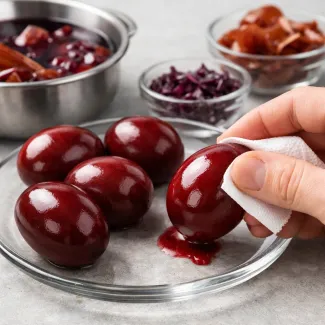
A warm egg rolls through colored rice, picking up pigment in broken, textured traces that settle into a layered surface. In Marbled Easter eggs with rice and dye for a textured festive finish, the shell stays smooth while the pattern appears almost tactile, creating contrast between visual depth and simple flavor, ideal for a calm, festive table setting.

Controlled surface imprinting for marbled egg patterns
How rice-based dye contact creates sharp texture and contrast
The egg moves slowly through colored rice, and the surface begins to build its pattern in fragments rather than layers. Each grain presses pigment onto the shell, leaving behind a broken, irregular imprint that defines the final look. This method sits within a broader system of shell preparation and dye control explained in egg dyeing techniques with smooth shell control. The first tactile signal is immediate: the shell touches, rolls, and lifts—creating sharp-edged color deposits instead of continuous coating.
Taste and texture profile
The edible structure remains stable; the surface defines perception.
- Taste: clean, neutral, lightly savory
- Aroma: minimal, no added aromatic compounds
- Mouthfeel: firm white, creamy yolk center
- Surface feel: smooth shell with visually granular patterning
- Visual contrast: high contrast, broken color fields
Technical logic of the structure
The result is governed by localized pigment transfer, not immersion.
- Acid (vinegar) modifies shell surface for stronger dye bonding
- Rice acts as a distributed contact matrix
- Rolling motion creates non-linear deposition points
- Dry shell ensures pigment remains fixed at contact zones
- Accumulation forms a mosaic-like texture without blending
Difference from other methods
This technique diverges clearly from standard approaches.
- Immersion dyeing → uniform, continuous color coverage
- Brush application → directional strokes, controlled placement
- Rice contact method → randomized, high-contrast fragmentation
- Pattern emerges from movement and pressure, not tools
For a stable base before patterning, see boiling eggs with smooth shells.
Practical quality signals
Correct execution produces clear, repeatable visual cues.
- Edges: sharply defined, no bleeding
- Distribution: irregular yet evenly spaced across the shell
- Contrast: visible base color between pigment deposits
- Dryness: matte surface without streaks or moisture marks
- Integrity: shell remains intact and structurally stable
Limitations of use
The method prioritizes texture over precision.
- Not suitable for fine detailing or graphic motifs
- Limited control over exact pattern placement
- Excess rolling reduces contrast and creates color saturation
- Residual moisture leads to smearing instead of imprinting
Storage and stability
Visual quality depends on maintaining surface conditions.
- Store in a dry, cool environment
- Avoid condensation that softens pattern edges
- Prevent direct contact between eggs to avoid pigment transfer
- Optimal visual stability within 24–48 hours
Professional culinary insight
The defining factor is not the dye, but the state of the surface at contact. A dry shell, lightly saturated rice, and controlled rolling pressure allow the pattern to form with clarity. When movement is brief, varied, and non-repetitive, the shell captures contrast without overloading pigment, preserving the distinct, fragmented texture that defines this technique.
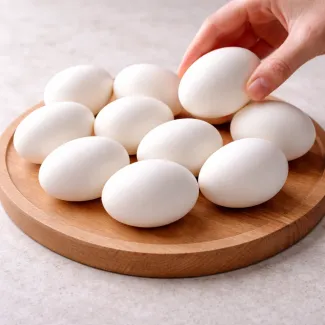
- Place eggs in a pot, cover with water and bring to a boil at 100°C (212°F).
- Cook for 10 minutes until hard-boiled.
- Transfer eggs into cold water and cool for 10 minutes.
- Drain and let eggs dry completely.
- Place rice into a bowl or plastic bag.
- Add food coloring and vinegar to the rice.
- Mix until rice is evenly colored.
- Add eggs and gently roll them in the rice until a marbled pattern forms.
- Remove eggs and place them on a rack or paper to dry for 10 minutes.
Work with eggs that are fully dry but still slightly warm; excess moisture breaks pigment adhesion and weakens surface stability. The rice must be evenly coated yet not wet, or the pattern diffuses instead of forming defined contact points. This balance between dryness and transfer defines the final structure—this is how it’s handled in practice by Chef PEKIS.
FAQ questionWhy do my eggs look blotchy instead of marbled?
If the shell is too wet, the dye spreads instead of transferring in fragments. Proper marbling depends on dry surface contact, not liquid flow. Let eggs air-dry fully before rolling them in rice.
Chef’s tip: In practice, uneven moisture is the first thing that disrupts pattern clarity.
FAQ questionHow do I get sharper, more defined patterns on the shell?
Use rice that is coated but not soaked. The grains should carry pigment as discrete contact points, not as a wet mass. Gentle rolling—not pressing—keeps the pattern crisp.
Chef’s tip: From a chef’s perspective, pressure control matters more than color intensity.
FAQ questionWhat if my colors look dull or faded after drying?
This usually means weak pigment bonding. A small amount of acid improves adhesion to the shell surface. Without it, color sits loosely and appears muted once dry.
Chef’s tip: It’s common to see dull tones when the surface chemistry is ignored rather than the dye quality.
FAQ questionCan I use natural dyes instead of food coloring for this method?
Yes, but expect softer contrast. Natural dyes tend to diffuse more, which reduces the sharp textural definition typical of rice marbling. The technique still works, but the result is more subtle.
Chef’s tip: In real kitchens, natural pigments are chosen for tone, not precision.
FAQ questionWhy do some areas of the egg remain completely uncolored?
This happens when rice doesn’t make consistent contact. The pattern forms through random distribution, so gaps are normal—but large blank areas suggest insufficient rolling or uneven rice coverage.
Chef’s tip: What looks like a flaw is often part of the visual balance of this technique.
FAQ questionIs this method suitable for preparing large batches for Easter gatherings?
Only to a point. Because the process relies on manual rolling and surface control, scaling up reduces consistency. For larger quantities, work in small batches to maintain pattern quality.
Chef’s tip: Experienced cooks accept slight variation as a sign of hand-crafted work rather than a defect.
The eggs rest quietly, their surfaces catching the last soft light of the afternoon. Colors settle into the shell as if they have always been there, shaped by a moment that has already passed. There is a sense of stillness in how they hold that pattern without effort.
Outside, the air shifts almost imperceptibly. Early spring carries a faint coolness, something clean and open, like soil just beginning to warm. The table feels lighter, less crowded, as if space itself has become part of the setting.
Hands slow down once the work is done. What remains is not movement, but a kind of pause—eggs placed gently into a bowl, the quiet contrast of smooth shells and broken color. In that pause, there is a soft balance between intention and chance.
Nothing asks for attention anymore. The room settles, the light softens, and the surface of each egg holds a quiet trace of the day, steady and complete.
- Eggs – main allergen; substitute with plant-based decorative eggs (non-edible) for allergen-free version
- Gluten-free – recipe naturally contains no gluten; ensure food coloring is certified gluten-free
- Vitamin B12 (mcg): 1 – supports nervous system and red blood cell formation
- Vitamin D (mcg): 1 – contributes to bone health and immune function
- Iron (mg): 1 – supports oxygen transport in the body
- Selenium (mcg): 15 – important for antioxidant defense and thyroid function
- Phosphorus (mg): 95 – supports bones and energy metabolism
- Lutein (mcg): 250 – supports eye health and reduces oxidative stress
- Zeaxanthin (mcg): 200 – helps protect vision and cellular integrity
- Selenium compounds (mcg): 15 – contribute to cellular antioxidant protection
Calculators



Recipes worth trying