A fork turns through pasta as a dense, glossy sauce clings without slipping, carrying slow-braised beef that breaks into soft fibers. In Slow-Braised Beef Ragu for Pasta with Rich Tomato Depth, time transforms simple elements into a unified structure where richness, gentle acidity, and deep aroma settle into a calm, satisfying finish.

Controlled reduction and structural balance in a slow-braised beef ragu
Why time, temperature, and fat integration define the final texture
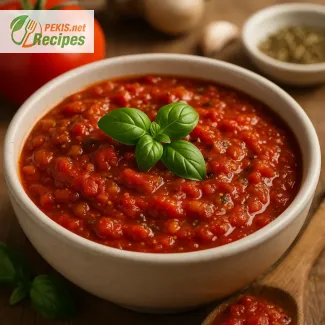
The fork turns through the pasta and meets resistance—not from dryness, but from density. The sauce does not run; it wraps, holding the strands together in a uniform layer. As the meat separates, it does not crumble randomly—it follows its natural fibers, staying embedded in the sauce. This is the defining moment of a properly built ragu: structure created through time, not thickening. The base often begins with a stable reduction like a homemade tomato passata, where water is already controlled before cooking even begins.
Flavor and texture profile
This dish is not built on contrast, but on progressive depth. Each element integrates into a unified whole.
- Primary flavor: deep, slow-developed umami from braised beef
- Acidity: present but softened through reduction, never sharp
- Sweetness: emerges naturally from long cooking, not added
- Fat integration: emulsified into the sauce, coating without separation
- Texture: thick, cohesive, with visible strands of meat
- Mouthfeel: dense, smooth, slightly elastic when clinging to pasta
Technical logic of the dish
The structure is a result of controlled transformation, not assembly.
- Collagen conversion: low heat over time transforms connective tissue into gelatin, giving body
- Reduction mechanism: gradual evaporation concentrates flavor and stabilizes viscosity
- Fat emulsification: rendered fat binds with liquid, preventing oily separation
- Tomato stabilization: acidity is moderated through cooking, supporting protein structure
A heavy vessel is critical. A stable thermal environment, as explained in how to use a Dutch oven, ensures the sauce simmers rather than boils, preserving structure.
Difference from similar preparations
Not all meat sauces follow the same logic. This ragu is defined by restraint.
- Built through time and reduction, not added thickness
- Sauce is structural, not fluid
- Meat remains in natural fibers, not finely minced
- Tomato acts as a binder, not the dominant flavor
Faster preparations often taste complete but lack cohesion. Here, cohesion is the goal.
Practical signals of quality
A finished ragu communicates its correctness visually and physically.
- No free liquid separating on the plate
- Meat fibers remain intact, yet break effortlessly
- Sauce adheres fully to pasta without pooling
- Surface gloss is even, without visible oil film
- Aroma is rounded, with no aggressive acidity
Limitations of use
This structure has boundaries.
- Not suited for delicate or thin pasta shapes
- Can feel overly heavy in warm environments
- Not optimal for rapid service cycles
- Reheating without control can over-tighten the sauce
Storage and stability
Time continues to influence the dish even after cooking.
- Cooling increases gel density, thickening the sauce
- Reheating requires gentle hydration control
- Flavor becomes more integrated after resting
- Extended storage can intensify salt and concentration
When scaling, structural ratios must remain intact. A tool like a portion calculator helps maintain consistency without diluting the result.
Professional culinary insight
A stable ragu is not achieved by adding, but by removing what is unnecessary—excess water, uncontrolled heat, fragmented fat. The decisive factor is not seasoning, but the point at which reduction, gelatin formation, and emulsification align. At that moment, the sauce stops behaving like liquid and begins to behave like structure.
- Cut beef into large chunks. Chop onion, carrot, celery, and garlic.
- Heat olive oil in a heavy pot. Sear beef on all sides until browned. Remove.
- Add vegetables and cook until softened.
- Stir in tomato paste and cook briefly.
- Pour in red wine and reduce by half.
- Add passata, beef stock, herbs, salt, and pepper. Return beef.
- Cover and cook at 150–160 °C (300–320 °F) for 2 hours 30 minutes.
- Remove beef and shred with forks.
- Return meat and simmer uncovered until thick.
- Serve hot over pasta.
Keep the ragu just below a boil; if the surface breaks or fat separates, the emulsion is failing and the structure will loosen. At the point where sauce coats the spoon without sliding, stability is reached—this is where timing matters more than ingredients. This is how Chef PEKIS works in practice, refining reduction until texture holds naturally.
FAQ questionHow do I know when the ragu is properly reduced and ready to serve?
Look for a sauce that coats pasta evenly without pooling on the plate. When you drag a spoon through it, the path should close slowly, not instantly. The meat should separate into soft strands, not crumble.
Chef’s tip: In practice, most people first notice the shine—when it turns from watery to silky and dense, the structure is already forming.
FAQ questionHow can I control temperature to avoid breaking the sauce?
Keep the ragu at a gentle simmer, never a rolling boil. Excess heat causes fat to separate and disrupts the emulsion, leading to an oily surface. A heavy pot stabilizes heat and prevents fluctuations.
Chef’s tip: From a working kitchen perspective, instability often begins when the surface starts moving too aggressively, not when the heat seems “high.”
FAQ questionWhat if my ragu turns too watery during cooking?
This usually means evaporation is too slow. Remove the lid and allow controlled reduction, stirring occasionally to prevent sticking. Avoid adding thickening agents—structure must come from reduction, not shortcuts.
Chef’s tip: It’s common that impatience leads to dilution; letting water leave naturally always builds deeper flavor than adding anything back.
FAQ questionCan I use ground beef instead of whole cuts?
Yes, but the result will be different. Ground meat creates a finer texture and less defined structure, lacking the natural fiber breakdown of slow-braised cuts. The sauce may feel flatter and less cohesive.
Chef’s tip: In many kitchens, the shift to ground meat is where the dish stops behaving like a ragu and starts acting like a simple meat sauce.
FAQ questionWhy does my sauce sometimes taste too acidic?
This happens when tomato hasn’t had enough time to reduce and stabilize. Continue cooking gently; acidity softens as water evaporates and sugars concentrate. Avoid adding sugar too early.
Chef’s tip: It’s often noticed that sharpness fades not with seasoning, but with time—acidity is rarely a problem of ingredients, but of patience.
FAQ questionIs a Dutch oven necessary, or can I use a regular pot?
A Dutch oven is ideal because it provides even heat retention and minimizes hot spots. A regular pot works, but requires more attention to prevent uneven reduction or scorching.
Chef’s tip: From experience, consistency in heat matters more than the tool itself—what counts is how stable the cooking environment feels over time.
FAQ questionHow should I adjust the recipe for different portion sizes?
Scale all ingredients proportionally, but maintain the same reduction time. Larger batches need wider surfaces for evaporation; otherwise, the sauce may stay too loose.
Chef’s tip: In practice, volume is less critical than surface area—many notice that doubling a recipe without adjusting the pot leads to weaker structure.
The plate settles into the quiet of the table, steam fading into the room as the evening light softens. Outside, the air holds a slight chill, the kind that lingers at the edge of open windows. Inside, there is only warmth—steady, grounded, without urgency.
A fork rests for a moment longer than needed. The sauce no longer moves, it simply holds, as if time itself has slowed with it. In that pause, the room feels fuller, not with noise, but with stillness that follows something done properly.
There is no need to adjust, no need to return to the stove. The dish has already settled into its final form, and the space around it mirrors that calm. Even the light seems to rest differently now, softer across the table, touching only what matters.
Some meals end with conversation. Others end in quiet recognition. This one leaves behind a sense of balance, where nothing calls for attention, and nothing feels missing.
Allergens & gluten:
- celery present
- sulfites from wine
- gluten-free if served without pasta or with gluten-free pasta
Substitutions:
- replace wine with additional stock
- replace celery with zucchini for allergen-free option
- Iron: 6 mg – supports oxygen transport
- Vitamin B12: 3 µg – supports nervous system
- Potassium: 700 mg – supports muscle function
- Vitamin A: 500 µg – supports vision
- Zinc: 5 mg – supports immune system
- Lycopene: 12 mg – supports heart health
- Polyphenols: 50 mg – reduce oxidative stress
- Beta-carotene: 3 mg – supports skin health
Calculators

Recipes worth trying