In a quiet kitchen moment, the shell gives nothing back to the touch—only a smooth, dry surface ready to hold color with precision. Properly handled, Boiling eggs for Easter dyeing with smooth shells and no cracks delivers firm whites and stable yolks, where structure matters more than flavor, and every detail supports a clean, even finish on the final dyed egg.
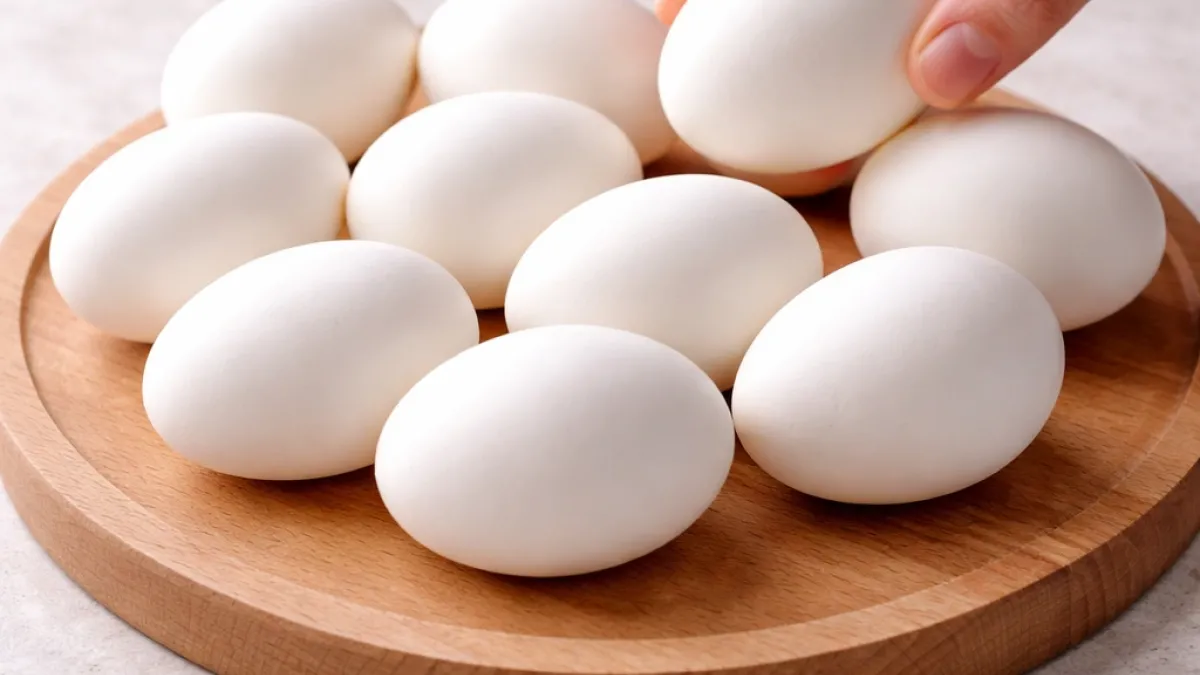
Stable shells for Easter dyeing with controlled heat and cooling
Smooth, crack-free eggs as the base for even color absorption
The moment the egg touches the surface, your fingers slide across a dry, smooth shell that reflects light evenly. There is no roughness, no resistance—only a stable surface ready to take on color. This tactile signal defines the outcome of natural egg dyeing, where pigment binds only as evenly as the shell allows.
Flavor and texture profile
Even in a technical base preparation, internal structure matters.
- Neutral taste: clean egg profile without sulfur dominance
- Firm white: fully set, elastic without rubberiness
- Stable yolk: compact center without discoloration
- Dry shell: essential for consistent dye adhesion
Technical structure of the egg
The outcome is driven by controlled protein coagulation.
- Egg white sets gradually under moderate heat
- Yolk stabilizes without pressure spikes
- Rapid temperature increase → internal expansion → shell stress
- Gentle heating → balanced pressure → intact shell
Cooling completes the structure:
- Immediate cold shock stops internal cooking
- Internal contraction stabilizes shell integrity
- Surface dries uniformly, preparing it for dyeing
This foundation is identical to the method described in boiling eggs for dyeing, where temperature control defines both structure and surface quality.
Difference from common variations
Many methods prioritize speed instead of structural control.
- Starting in boiling water → sudden pressure → cracks
- Strong boiling → movement → collisions and damage
- No cooling phase → residual heat → weakened shell
This method focuses on:
- progressive heat increase
- minimal water agitation
- immediate stabilization through cooling
Practical quality signals
A correctly prepared egg shows clear indicators:
- Shell fully intact, no fractures or hairline cracks
- Uniform matte surface, no chalky patches
- No leakage traces during cooking
- Shape preserved, no deformation
- Clean peeling behavior without tearing
Limitations of use
This preparation is optimized for dyeing precision.
- Not suitable for:
- prolonged exposure to warm environments
- stacking or transport under pressure
- Sensitive to:
- condensation before dyeing
- rapid reheating or temperature shifts
Storage and structural stability
After cooling, the egg enters a stable phase.
- Store dry in refrigeration
- Avoid moisture accumulation on the shell
- Over time:
- shell remains stable
- interior becomes slightly firmer
- Before dyeing:
- ensure a completely dry surface
Professional culinary insight
The decisive factor is not cooking time but thermal control and internal pressure balance. When heat rises gradually and stops precisely, the shell remains neutral—without stress points or microfractures. This neutrality allows color to settle evenly, without streaks, patching, or uneven absorption.
- Bring eggs to room temperature
- Place eggs in a single layer in a pot
- Cover with cold water
- Add salt
- Heat slowly until gentle simmer at 100°C (212°F)
- Maintain low simmer without strong boiling
- Cook for 9–10 minutes
- Remove from heat
- Transfer immediately to ice water
- Chill for 10 minutes
- Remove and dry completely
Keep the water just below a rolling boil and watch the shell after cooling—any fine line means the internal structure was stressed too fast. The goal is quiet, even heat that lets proteins set without pressure. That’s how consistent dyeing surfaces are built in practice, step by step. This is how it’s done in real kitchens by Chef PEKIS, where stability always comes before appearance.
FAQ questionHow can I tell if eggs are properly cooked for dyeing?
A correctly prepared egg shows a completely smooth shell, no hairline cracks, and no chalky residue on the surface. When gently rotated, it feels firm and balanced, not fragile. Inside, the white is set and the yolk is compact without discoloration.
Chef’s tip: In practice, people first notice imperfections only after dyeing, when uneven color reveals hidden surface flaws.
FAQ questionWhat is the most reliable way to control temperature during boiling?
Start from cold water and raise the heat gradually until a gentle simmer—not a rolling boil. Maintain minimal water movement to prevent collisions. This stabilizes protein coagulation and avoids internal pressure shifts that crack shells.
Chef’s tip: From a professional perspective, the difference between simmering and boiling is often what separates clean shells from damaged ones.
FAQ questionWhat if an egg cracks slightly during cooking—can it still be used?
A cracked egg can still be eaten, but it is no longer suitable for dyeing. Even small fractures allow water to enter, creating uneven texture and preventing uniform color absorption. For visual results, discard cracked shells from the dyeing batch.
Chef’s tip: It’s common to underestimate microcracks—these often only become visible once color is applied.
FAQ questionWhy do some eggs develop a gray-green ring around the yolk?
This happens when eggs are overcooked or cooled too slowly. The reaction between sulfur in the white and iron in the yolk forms this ring. While safe to eat, it signals structural imbalance and reduced visual quality for dyed eggs.
Chef’s tip: In kitchens, this ring is often treated as a timing issue rather than a flavor problem.
FAQ questionDoes egg size or origin affect the final result?
Yes. Larger eggs require slightly more time for even internal setting, while very fresh eggs may have tighter membranes that react differently to heat. In many European kitchens, medium eggs offer the most predictable thermal stability.
Chef’s tip: It’s interesting how consistency improves when using eggs of the same batch—variation is often the hidden variable.
FAQ questionCan I skip the ice bath if I’m in a hurry?
Skipping rapid cooling increases the risk of residual cooking and delayed cracking. The shell may appear intact at first but develop fine fractures as internal heat redistributes. Immediate cooling locks the structure.
Chef’s tip: In practice, structural problems often appear minutes later, not during cooking itself.
FAQ questionWhy is a gentle simmer better than a rolling boil?
A rolling boil creates turbulence, causing eggs to knock against each other and the pot. This leads to micro-damage and stress fractures. A gentle simmer keeps eggs stable and supports even heat distribution.
Chef’s tip: Many cooks associate stronger boiling with control, but in reality, it often reduces precision.
FAQ questionHow do I prevent eggs from cracking when taken from the fridge?
Allow eggs to rest at room temperature before cooking. Sudden temperature shifts create internal pressure differences between the shell and contents, leading to cracks. Gradual warming ensures structural balance.
Chef’s tip: From experience, temperature shock is one of the most overlooked causes of failure in otherwise simple preparations.
The eggs rest quietly on the surface, their shells holding a soft reflection of the late afternoon light. There’s a sense of stillness now, as if the process has stepped aside and left only form behind—clean, unbroken, ready for what comes next.
Outside, the air shifts slightly, carrying that early hint of spring. It’s the kind of moment where preparation feels complete, even before the colors arrive. The shells remain untouched, almost deliberate in their simplicity.
In the kitchen, nothing moves quickly. Hands slow down, attention narrows, and the focus settles on small details—the curve of each egg, the way light traces its surface. This quiet pause becomes part of the ritual.
What remains is a kind of balance—between heat and cooling, between effort and ease. And in that space, the eggs hold their place, waiting, steady and whole.
- Eggs – allergen; substitute with plant-based egg alternatives for non-dyeing recipes
- Gluten-free – no gluten present
- Vitamin A (µg): 80 – supports vision and immune function
- Vitamin D (µg): 1 – helps calcium absorption and bone health
- Vitamin B12 (µg): 1 – essential for nerve function and red blood cells
- Iron (mg): 1 – supports oxygen transport in the body
- Selenium (µg): 15 – antioxidant support and thyroid function
- Lutein (mg): 0.2 – supports eye health and reduces oxidative stress
- Zeaxanthin (mg): 0.2 – protects vision and retina from damage
- Selenium compounds (µg): 15 – contributes to cellular antioxidant defense
Calculators
Recipes worth trying