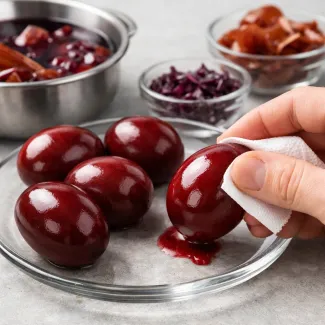
A smooth rotation under light reveals a flawless metallic surface that feels dry and perfectly even. In How to create golden Easter eggs with smooth metallic shine without streaks, the finish defines the moment—clean reflections, no streaks, and a calm visual balance that elevates the festive table without excess decoration or distraction.

Metallic golden Easter eggs with controlled shine and surface precision
Uniform coating, dry shell and reflective finish without streaks
Placed on a bright Easter table, the egg catches the light before anything else—the surface reflects like polished metal as the brush glides across and the matte shell transforms into a clean gold finish. That precise moment of reflection defines the technique, and it builds on a stable base explained in natural Easter egg dyeing and the technical foundation of boiling eggs for dyeing.
Taste and texture profile
Although primarily decorative, the egg retains its natural culinary structure:
- Neutral, clean egg flavor without added notes
- Firm white and stable yolk with no dryness or discoloration
- Completely dry shell surface enabling a uniform metallic layer
The focus shifts from flavor complexity to visual and tactile precision, where surface defines quality.
Technical structure and mechanism
The metallic finish emerges from controlled physical transitions:
- Protein coagulation stabilizes the internal structure during boiling
- Complete surface drying removes micro-moisture that disrupts adhesion
- Thin-layer pigment application creates reflective alignment
- Rapid alcohol evaporation fixes the coating without streaking
The shine is achieved through layer control, not thickness—multiple micro-layers form a consistent reflective surface.
Difference from other decorative methods
This method differs clearly from other egg decoration techniques:
- Natural dyes (see natural dyeing methods) penetrate the shell → soft, matte tones
- Marbling (see textured marbled eggs) creates irregular visual patterns → intentional variation
- Metallic coating remains on the surface → requires precision, control and dryness
The result is more visually controlled and technically demanding than diffusion-based methods.
Practical quality signals
Correct execution is immediately visible:
- Uniform metallic reflection across the entire shell
- No streaks, brush lines or uneven patches
- Consistent gold tone without pigment pooling
- Dry, smooth surface with no tackiness
These signals confirm correct layering and timing.
Limitations of use
The finish is sensitive to environmental factors:
- Exposure to humidity or condensation can disrupt the surface
- Frequent handling may reduce uniformity
- Not ideal for long outdoor display or transport
Best suited for short-term presentation in controlled indoor conditions.
Storage and stability
To preserve the result:
- Store in a dry, cool space
- Avoid enclosed containers while residual moisture is present
- Maintain minimal handling to protect the surface
A stable environment maintains the reflective integrity.
Professional insight
The decisive factor is not the choice between brush or spray, but the discipline of surface preparation and layer control. A perfectly smooth, fully dried shell allows the metallic pigment to align evenly, while any residual moisture or excess application immediately breaks the reflection. Precision, not decoration, defines the final result.
- Bring eggs to room temperature.
- Add water, vinegar, and salt to a saucepan.
- Place eggs gently into cold water.
- Heat to 95–100°C (203–212°F) without strong boiling.
- Cook for 9–10 minutes.
- Transfer eggs immediately into cold water.
- Cool for 10–15 minutes.
- Dry eggs completely with a cloth.
- Mix metallic color with alcohol until smooth.
- Apply a thin layer using a brush or spray evenly.
- Let dry for 30–45 minutes.
- Polish gently with a soft cloth for shine.
Apply metallic color only to a fully dry shell at room temperature; any residual moisture breaks surface stability and creates streaks. Keep layers thin and let each pass set before the next. This is where precision shows—... Näin työskentelee Chef PEKIS, refining technique into clean, repeatable finishes.
FAQ questionWhy do my golden Easter eggs show streaks instead of a smooth metallic finish?
Streaks usually appear when the shell is not fully dry or when the coating is applied too thickly. A proper metallic finish depends on thin, even layers and a stable, dry surface. Moisture disrupts adhesion and creates uneven reflection.
Chef’s tip: In practice, the first imperfection often shows under angled light, not straight on.
FAQ questionHow can I control the surface for a perfectly even metallic shine?
The key is surface stability. After boiling, allow the eggs to dry completely at room temperature. Apply the metallic layer using controlled strokes or a fine mist, always in thin passes. Let each layer set before adding another to avoid pooling.
Chef’s tip: From a chef’s perspective, the surface behaves predictably only when temperature and dryness are aligned.
FAQ questionWhat if the metallic coating looks patchy after drying?
Patchiness often comes from uneven application or residue on the shell. Lightly polish the surface and reapply a thin layer. Avoid overworking the same area, as repeated brushing breaks the coating structure and reduces shine.
Chef’s tip: It’s common to notice that fixing too aggressively creates more irregularity than the original flaw.
FAQ questionIs it better to use a brush or spray for metallic Easter eggs?
A brush offers precision control, ideal for small batches and detailed work. A spray creates a more uniform layer faster but requires distance control to prevent droplets. The choice depends on whether you prioritize control or speed.
Chef’s tip: In real kitchens, consistency often comes from mastering one tool rather than switching between methods.
FAQ questionHow do I prevent eggs from cracking during boiling?
Start with room temperature eggs and avoid rapid boiling. Gentle heating keeps internal pressure stable and protects the shell structure. Sudden temperature changes are the main cause of cracks.
Chef’s tip: Many cooks underestimate how much movement in the pot contributes to micro-cracks.
FAQ questionWhy does the metallic shine fade after handling?
Frequent handling introduces oils and friction, which dull the surface. The metallic layer is stable but sensitive to touch. Keep handling minimal once the finish is set.
Chef’s tip: You’ll often notice that the first fingerprints appear where the egg was tested, not where it was displayed.
The light settles softly across the table, catching each curve in a quiet, steady glow. What remains is not movement, but stillness—a surface that holds the day without asking for attention.
Somewhere nearby, a window is slightly open. The air carries that faint shift of season, the kind that lingers between cool and warm. In that pause, the eggs rest untouched, their finish intact, reflecting just enough to feel alive.
Nothing more is added. No rearranging, no adjustment. The scene holds because it doesn’t try to change. This is where the moment finds its balance—in calm, in restraint, in knowing when to stop.
And as the room grows quieter, the surface keeps its soft glow, steady and uninterrupted, like the last light before evening settles in.
- Eggs – main allergen; replace with wooden or ceramic eggs for decorative use
- Gluten – not present; no substitution required
- Vitamin A (mcg): 75 – supports vision and immune function
- Vitamin D (mcg): 1 – supports bone health and calcium absorption
- Vitamin B12 (mcg): 1 – supports nerve function and red blood cells
- Iron (mg): 1 – supports oxygen transport in blood
- Selenium (mcg): 15 – supports antioxidant defense
- Lutein (mg): 0.2 – supports eye health
- Zeaxanthin (mg): 0.2 – protects vision and reduces oxidative stress
- Vitamin E (mg): 1 – supports cell protection and skin health
Calculators





Recipes worth trying