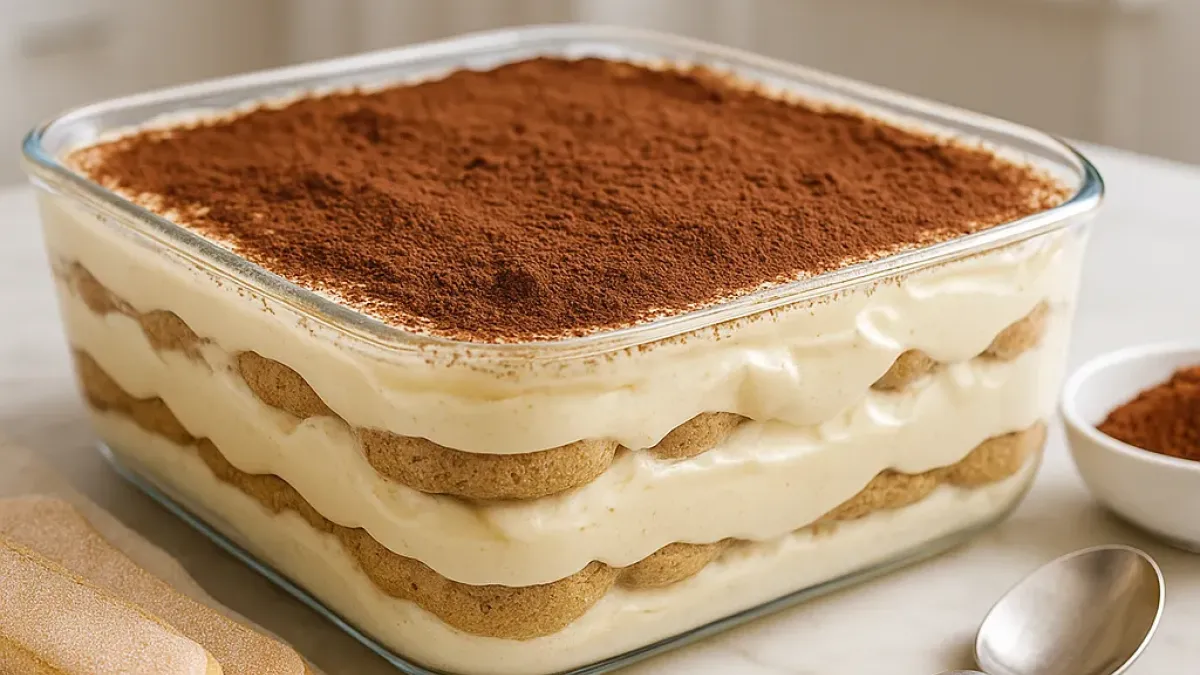
Soft espresso notes and airy mascarpone layers define the calm elegance of Family-Style Alcohol-Free Tiramisu Without Liqueur. Each slice reveals clean cream bands and gently soaked biscuits, finished with a dry cocoa veil that balances richness. Designed for shared tables, it delivers depth and structure without liqueur, keeping the flavor focused and refined.
Structure and Stability in Alcohol-Free Tiramisu
How Classic Layer Logic Works Without Liqueur
Family-Style Alcohol-Free Tiramisu Without Liqueur follows the same structural discipline as an Authentic Italian Tiramisu Recipe with Mascarpone Cream and Espresso, but removes the alcoholic component without weakening its identity. The result is not a simplified dessert. It is a controlled reinterpretation built on balance, hydration, and aeration.
At its core, tiramisu is a moisture-managed layered system. Each element carries a specific function:
- Espresso provides bitterness and controlled saturation.
- Ladyfingers act as absorbent structure.
- Mascarpone cream creates fat-based stability.
- Cocoa forms a dry aromatic finish.
When liqueur is removed, espresso must carry full aromatic weight. That increases the importance of extraction quality and dipping control.
Flavor Architecture
The flavor profile relies on contrast rather than intensity.
- Bitterness from espresso anchors the dessert.
- Dairy richness softens sharp coffee notes.
- Sugar moderates, but must not dominate.
- Cocoa introduces a dry finish that prevents palate fatigue.
Without alcohol, the dessert becomes cleaner and more direct. There is no aromatic lift from spirits, so clarity matters. The espresso must taste intentional, not diluted.
A properly balanced alcohol-free version should taste:
- Rounded, not sharp
- Cream-forward, not sugary
- Structured, not heavy
Texture Logic and Mechanical Structure
Tiramisu is defined by its internal layering mechanics. Stability depends on controlled aeration and moisture timing.
Cream Behavior
The mascarpone mixture must achieve three structural conditions:
- Yolks emulsified with sugar to form density
- Whites whipped to medium peaks for lift
- Gentle folding to preserve internal air
Overmixing collapses volume. Undermixing causes streaking and uneven firmness.
Biscuit Hydration
Ladyfingers must be dipped briefly. Proper hydration creates:
- Soft interior
- Defined external outline
- No liquid pooling
Excess soaking results in collapse and sliding layers.
Resting Phase
Chilling at 4°C allows:
- Fat solidification
- Moisture redistribution
- Clean vertical slicing
A minimum of six hours is structural, not optional.
Practical Quality Signals
Professional evaluation relies on visible and tactile cues.
High-quality alcohol-free tiramisu shows:
- Even cream layers with no separation
- Cocoa dusting dry and matte
- No syrup accumulation at the base
- Slice holds shape without spreading
Common faults include:
- Grainy mascarpone texture
- Soggy lower biscuit layer
- Overly sweet profile masking espresso
Difference from Variations
Many variations introduce fruit, chocolate chips, flavored syrups, or stabilized whipped cream. This version avoids structural shortcuts.
Key distinctions:
- No cream cheese substitution
- No gelatin stabilization
- No flavored extracts
- No decorative toppings
Its identity remains anchored in layered dairy-espresso contrast.
Removing liqueur does not reduce authenticity of structure. It simply shifts aromatic emphasis toward coffee purity.
Use Context and Limitations
This dessert performs best in shared settings:
- Family lunches
- Multi-generational gatherings
- Alcohol-free celebrations
It is not ideal for:
- Outdoor warm service
- Extended buffet display without refrigeration
- Freezing and thawing cycles
The cream relies on refrigeration stability. Heat compromises its architecture.
Storage Discipline
Proper storage preserves both flavor and texture.
- Store at 4°C
- Keep covered to prevent surface drying
- Dust cocoa just before serving
- Consume within 48 hours
Freezing disrupts mascarpone structure and creates water separation upon thawing.
Professional Insight
The strength of Family-Style Alcohol-Free Tiramisu Without Liqueur lies in restraint. When alcohol is removed, precision must increase. Espresso quality becomes more visible. Folding technique becomes more critical. Resting time becomes structural insurance.
This dessert rewards control. It does not need embellishment. Its authority comes from disciplined layering and balanced bitterness.
- Brew the espresso and let it cool completely to room temperature, below 25°C (77°F).
- Separate the eggs into yolks and whites.
- Whisk the egg yolks with the sugar until pale and thick, forming a ribbon texture.
- Add the mascarpone to the yolk mixture and mix gently until smooth and uniform.
- Whisk the egg whites with salt until medium peaks form.
- Fold the whipped whites into the mascarpone mixture carefully to keep the cream airy.
- Dip each ladyfinger briefly into the cooled espresso. Do not soak.
- Arrange a first layer of dipped ladyfingers in a rectangular dish.
- Spread half of the mascarpone cream evenly over the biscuits.
- Repeat with a second layer of dipped ladyfingers.
- Cover with the remaining cream and smooth the surface.
- Refrigerate at 4°C (39°F) for at least 6 hours, ideally 8–12 hours.
- Dust evenly with cocoa powder just before serving.
Chill the tiramisu at 4°C and check the cut edge—if it holds a clean line, the structure is set; if it slumps, the cream was overmixed or the biscuits oversoaked, breaking the emulsion balance. I rely on visual stability more than time alone, a habit shaped in daily service kitchens.
Chef PEKIS – professional chef and recipe developer with over 25 years of hands-on experience. I refine classic techniques into reliable, repeatable results for the home kitchen.
FAQ questionWhy does my tiramisu feel too soft when I slice it?
A soft slice usually means the internal stability hasn’t set. Either the cream was overworked and lost air, or the ladyfingers absorbed too much espresso. The cut surface should hold a defined edge with visible cream bands. If it spreads, it needs more chilling at 4°C and better dipping control next time.
Chef’s tip: Dip quickly—one second per side—and always chill overnight for clean structure.
FAQ questionHow can I improve the cream’s texture without making it heavy?
Focus on controlled emulsion and proper folding. Whip yolks with sugar until thick and pale; this builds density. Whip whites only to medium peaks—too stiff and they resist folding, too soft and they collapse. When folding in, use wide, deliberate strokes from bottom to top, rotating the bowl. Avoid rapid stirring; it destroys aeration and leads to a dense cream.
Chef’s tip: Stop folding when no white streaks remain—overmixing after that point flattens the texture.
FAQ questionCan I use store-bought espresso or instant coffee instead of freshly brewed?
You can, but strength matters. Many ready-made espresso drinks are diluted and slightly sweetened, which shifts the flavor balance. If using instant coffee, dissolve it at a higher concentration than drinking strength to maintain proper bitterness. The dessert depends on a clear coffee backbone without alcohol to mask weakness.
Chef’s tip: Taste the cooled coffee before dipping—if it feels thin, it will taste thin in the finished tiramisu.
Late afternoon light settles across the table, softening the edges of porcelain and glass. The cocoa top rests in quiet contrast to the pale cream beneath, untouched for a moment longer. There is a pause here, a small pocket of stillness before spoons break the surface.
Outside, the air carries a faint coolness, the kind that signals the turn of the season. Inside, conversation slows. Coffee lingers on the palate, not loud, just present—steady and grounding.
A shared dessert has its own rhythm. Plates pass gently, slices hold their line, and the room feels balanced. In that calm after preparation, there is only the simple weight of the day easing into evening, and the quiet assurance of something made with care.
Allergens & gluten + substitutions
- Contains eggs
- Contains milk
- Contains gluten
Substitutions:
- Replace ladyfingers with certified gluten-free sponge biscuits.
- Use pasteurized egg products for safer raw egg handling.
- Dairy-free mascarpone alternatives may be used, but texture will differ.
- Vitamin A 610 IU – supports vision and immune function
- Vitamin D 2 µg – supports bone health
- Vitamin B12 1 µg – supports nervous system
- Calcium 130 mg – supports bones and teeth
- Iron 1 mg – supports oxygen transport
- Potassium 140 mg – supports muscle function
- Phosphorus 150 mg – supports cellular energy
- Polyphenols 35 mg – support cellular protection
- Flavonoids 20 mg – support cardiovascular health
- Theobromine 25 mg – mild stimulant effect
- Vitamin E 1 mg – supports cell membrane protection
Calculators
Recipes worth trying