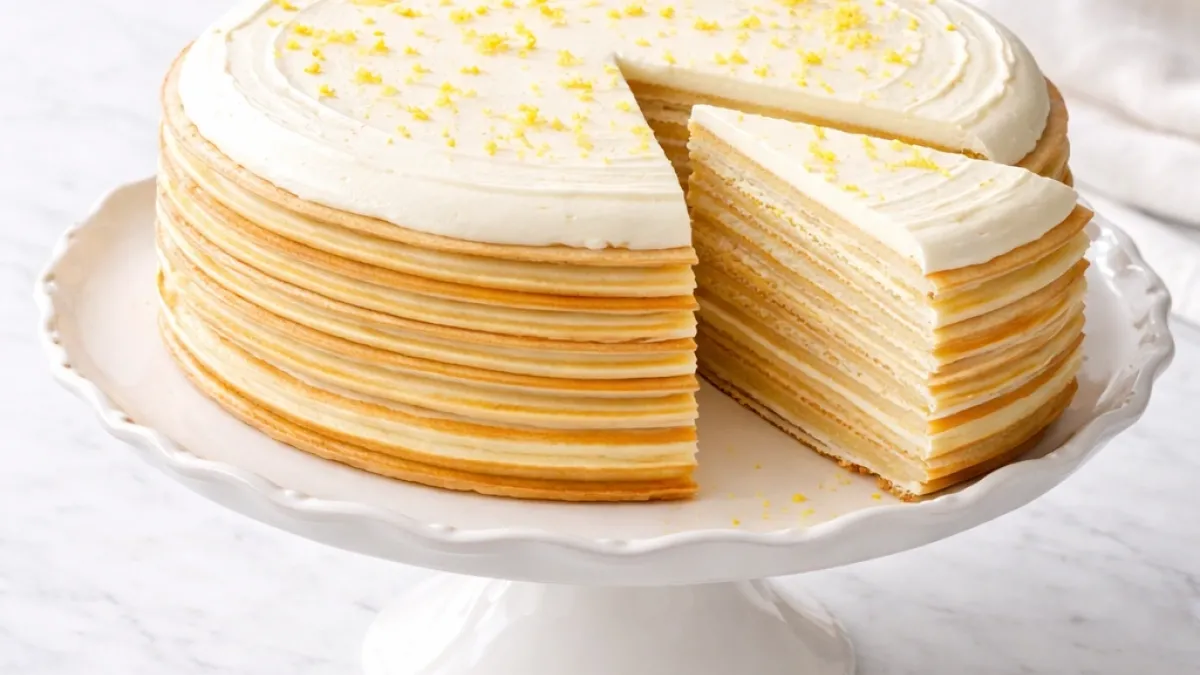
Thin layers meet a soft, stable cream in a slice that stays perfectly defined. The Pancake Cake with Cream Filling for Birthday Dessert Table feels lighter than it looks, with gentle vanilla notes and a clean citrus whisper on top. Served chilled, it cuts smoothly, revealing calm, even stripes that turn a simple gathering into a composed, elegant moment around the cake stand.
When Thin Pancakes Become a Celebration Cake
A layered dessert that slices clean and feels lighter than it looks
The first cut surprises people. You expect softness to collapse, yet the knife glides through neat, even layers. The scent is quiet—warm dairy, a trace of vanilla, a hint of citrus. Pancake Cake with Cream Filling for Birthday Dessert Table does not rely on height alone; it wins with structure and restraint.
Entering the Layers
This cake begins where classic crêpes begin. The foundation is the same thin, flexible base you would use for an Authentic French Crêpe Recipe – Easy and Delicious, but here the goal shifts. Instead of folding or rolling, the pancakes become architecture. Each one is a measured layer, flat and even, stacked with calm precision.
On the plate, the cross-section is the statement. Pale cream alternating with golden edges. No heavy piping, no overloaded topping—just a smooth surface and visible rhythm. It belongs at a birthday dessert table, where guests want something elegant but not overly rich.
A Quiet European Influence
Layered pancake cakes echo Central and Northern European traditions where crêpes are stacked rather than folded. The technique respects simplicity. It is closer in spirit to café pastry than to bakery spectacle—meant to be sliced and shared in steady portions.
How It Is Served
This cake is served chilled but not cold. The cream holds its shape, yet the pancakes remain tender. A clean wedge is lifted onto a white plate, the layers clearly defined. It pairs naturally with coffee in the afternoon or with a light sparkling drink in the evening. The texture carries the experience more than decoration.
What Makes It Different
Many celebration cakes depend on sponge height or buttercream weight. This one depends on repetition and balance. Thin layers prevent heaviness. Mascarpone stabilizes without turning dense. The result feels refined and controlled rather than indulgent.
Why You’ll Like It
- Clean slices that hold shape on the table
- Balanced sweetness without frosting overload
- Make-ahead stability for stress-free hosting
- A look that feels modern yet familiar
PEKIS Chef’s Insight: Layer Discipline
In practice, the key is restraint. Each pancake must be thin enough to bend, never crisp. Each layer of cream must be even, never excessive. If you want to understand the structure behind a stable filling, the guide to Mascarpone cream for the cake explains how lightness and stability coexist.
This cake is not about decoration; it is about rhythm—pancake, cream, pancake, cream—until the structure feels complete.
Creative Variations Without Losing Identity
Seasonally, a touch of citrus zest works in spring. In winter, a deeper vanilla tone suits candlelight gatherings. The core must remain visible layers and smooth cream. If you prefer a rustic pancake experience, something like the Fluffy Kaiserschmarrn Recipe – Austrian Shredded Pancake with Rum-Raisins shows how texture changes when pancakes are torn instead of layered—an entirely different direction.
When It Is Not Ideal
If you need a cake that stands outdoors in summer heat for hours, this is not the right choice. It is designed for indoor tables, moderate temperatures, and calm slicing.
Make-Ahead and Storage
It benefits from rest. Several hours in the refrigerator allow the layers to settle and bind. The surface firms slightly, and the knife leaves clean lines. The following day, the texture remains soft but more unified.
PEKIS Chef’s Perspective on Rhythm and Season
A layered pancake cake fits gatherings that move slowly—afternoon birthdays, weekend family tables, moments when conversation lasts longer than candles. It feels composed, not extravagant. It proves that repetition, when done precisely, creates something quietly impressive.
- In a large bowl, whisk flour, sugar and salt.
- Add eggs and half of the milk. Whisk until smooth.
- Add remaining milk, melted butter and vanilla. Mix to a thin batter.
- Let the batter rest for 20 minutes at room temperature.
- Heat a 22 cm pan over medium heat (approx. 170–180°C / 340–355°F surface temperature).
- Pour a thin layer of batter and cook 60–90 seconds per side until lightly golden.
- Repeat until at least 12 thin pancakes are made. Cool completely on a flat surface.
- In a chilled bowl, whip heavy cream to soft peaks.
- In another bowl, mix mascarpone, powdered sugar and vanilla until smooth.
- Fold whipped cream into mascarpone mixture until stable and airy.
- Place one pancake on a serving plate. Spread about 60 g of cream evenly.
- Repeat layering pancake and cream until all pancakes are stacked.
- Smooth the top with a thin final layer of cream.
- Refrigerate the cake for minimum 4 hours (optimal 6–8 hours) until firm.
- Slice with a warm knife for clean layers.
Chill the cake until the cream feels firm at the center; if it wobbles, the structure is not set and slicing will drag the layers. Proper folding keeps the mascarpone and whipped cream in a stable emulsion, not a dense mass. I rely on this balance every time I build layered pancakes, where even pressure defines the final cut — Chef PEKIS – professional chef and recipe developer with over 25 years of hands-on experience. I refine classic techniques into reliable, repeatable results for the home kitchen.
FAQ questionHow do I know the pancake cake is properly set before slicing?
Look at the sides. The layers should appear compact and evenly aligned, without bulging cream. Press gently on the top — it should feel firm yet elastic, not soft or jiggly. When you run a warm knife through, the cut should reveal clean, defined stripes. If the cream smears, it needs more chilling for full stability.
Chef’s tip: Warm the knife in hot water and wipe it dry between slices for sharp, professional edges.
FAQ questionCan I improve the structural integrity of the layers for taller cakes?
Yes. Control your cream’s aeration. Whip the cream only to soft-to-medium peaks before folding into mascarpone. Overwhipping creates graininess; underwhipping weakens the stack. Keep pancakes uniform in thickness and apply consistent pressure when stacking. Temperature matters — assemble in a cool kitchen to prevent softening.
Chef’s tip: Chill the plate before stacking to slow down cream softening during assembly.
FAQ questionWhat if my pancakes turn slightly crisp at the edges?
That usually means the pan is too hot or the batter hydration is off. Crisp edges won’t bond properly with cream and may cause uneven layers. Lower the heat and ensure the batter flows thinly and evenly. If needed, trim the edges while still warm to maintain clean geometry.
Chef’s tip: Aim for pale golden pancakes — deep browning compromises flexibility.
FAQ questionCan I use American all-purpose flour brands without adjusting the recipe?
Most U.S. all-purpose flours work well, but protein content varies slightly by brand. Higher-protein flour can make pancakes less tender. If your flour feels strong, add 1–2 tablespoons of milk to loosen the batter for smoother spreading and lighter texture. The goal is a fluid batter that coats the pan thinly.
Chef’s tip: Let the batter rest fully; hydration improves elasticity and prevents tearing during flipping.
Late afternoon light settles across the table, catching the pale layers as the room grows quieter. Plates are cleared slowly. The air carries a trace of vanilla and warm milk, softened now by cool evening air drifting in through a cracked window.
A slice rests on porcelain, clean lines still visible, cream steady and calm. Conversation lowers into stillness, the kind that follows shared laughter and second helpings. Nothing feels hurried.
Outside, the sky shifts toward a muted blue. Inside, candles flicker gently, reflecting off the smooth surface of the cake stand. The rhythm of the day slows, and the table feels grounded in balance.
In that quiet pause — just before dishes are stacked and lights are dimmed — there is a sense of ease, a simple completeness that lingers long after the last fork is set down.
- Gluten: from wheat flour
- Milk: heavy cream, mascarpone, butter
- Eggs: whole eggs
Substitutions:
Gluten-free flour blend can replace wheat flour.
Lactose-free cream and lactose-free mascarpone alternatives can replace dairy.
Egg replacement is not recommended for structure stability in this recipe.
- Vitamin A (µg): 210 – supports vision and immune function
- Vitamin B12 (µg): 0.9 – essential for nerve health
- Calcium (mg): 118 – supports bone structure
- Iron (mg): 0.8 – supports oxygen transport
- Potassium (mg): 142 – supports fluid balance
- Lutein (mg): 0.09 – supports eye health
- Zeaxanthin (mg): 0.05 – protects retinal cells
- Vitamin E (mg): 0.7 – protects cells from oxidative stress
Calculators
Recipes worth trying