Homemade Kataifi Dough with Fine, Crisp Threads for Pastries is a neutral, ultra-thin dough designed to create light, structured desserts with a delicate crunch. Known for its fine strands and clean wheat aroma, it forms airy layers that hold syrups, nuts, creams, or fruit without heaviness. Rooted in Eastern Mediterranean pastry tradition, this dough delivers contrast through texture rather than flavor.
When ultra-thin dough turns into structure
The quiet craft behind crisp kataifi threads
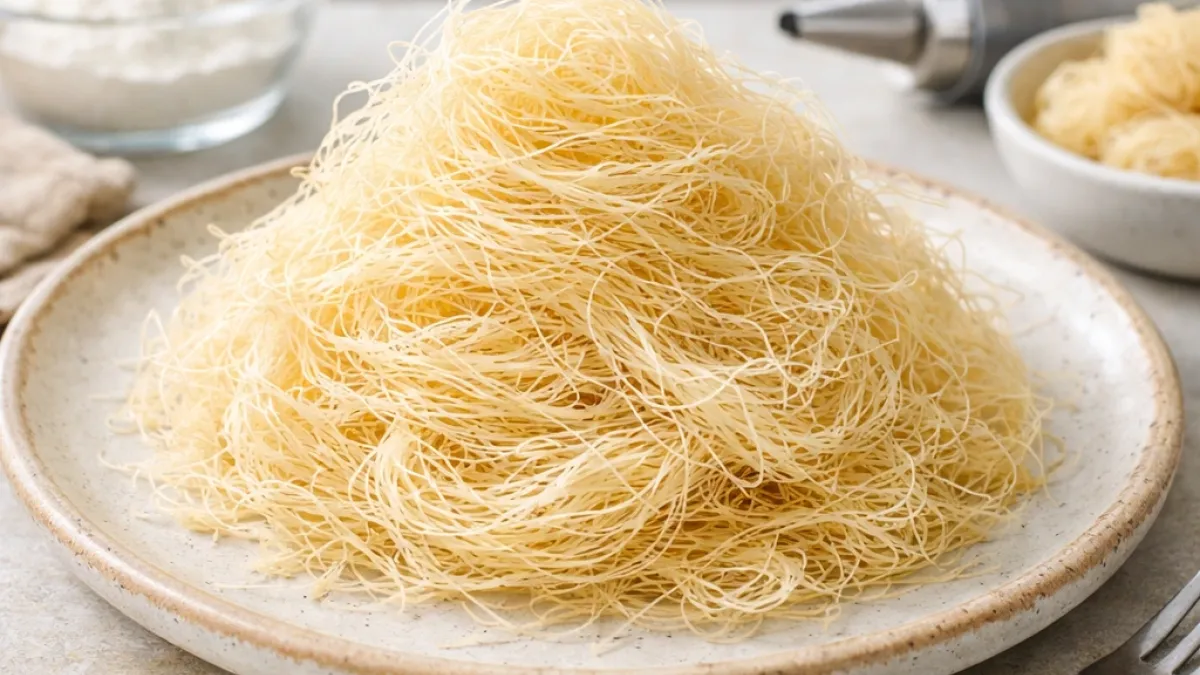
Kataifi looks fragile, almost accidental, yet it behaves with precision. The first contrast hits immediately: what resembles a loose tangle of fine threads becomes structured, crisp, and controlled once baked. When fresh, the dough smells faintly of flour and clean starch; when handled, it feels dry on the surface but still alive, flexible, ready to be shaped.
A dough defined by texture, not flavor
Kataifi does not announce itself with taste. Its role is architectural. Across Eastern Mediterranean pastry traditions, this dough exists to carry syrup, nuts, cream, or fruit without collapsing. The strands trap air, create lift, and turn fillings into layers rather than weight. That restraint is exactly what makes it valuable.
How kataifi is experienced on the plate
Served well, kataifi is never dense. It shatters lightly under the fork, then softens as it meets warm filling or syrup. In nests, it feels delicate and intentional; in rolls, it offers contrast between a crisp exterior and a tender core. The pleasure comes from sound and resistance, not sweetness.
What makes kataifi different from other pastry doughs
Unlike laminated doughs, kataifi relies on strand separation, not fat layers. Unlike shredded phyllo substitutes, true kataifi keeps its threads intact from pan to oven. This is why understanding dough flow and drying matters more than speed. The dough is simple; the control is not.
Why this dough earns a place in your kitchen
- Creates structure without heaviness
- Adapts to both baked and syrup-soaked desserts
- Pairs cleanly with nuts, creams, fruit, and honey
- Scales visually, from refined plating to rustic trays
PEKIS Chef’s insight (Chef’s practical note)
In professional kitchens, kataifi is judged before baking. If the strands separate cleanly and feel dry but flexible, the bake will be even. If they clump, no oven can fix it.
Creative variations worth exploring
Kataifi isn’t limited to classic nut fillings. It works beautifully wrapped around soft cheeses, layered with citrus curds, or baked into thin discs used as crunchy bases. Its neutrality makes it compatible with techniques you may already use in doughs like Homemade Pizza Dough with a Crisp Edge and Soft Center for Baking, where structure and hydration define the result.
When kataifi is not the right choice
This dough is unforgiving in humid environments and rushed workflows. If you need speed, softness, or elasticity after baking, a sponge-based option like Ladyfingers Recipe (Savoiardi – Sponge Fingers for Tiramisu & Desserts) will behave more predictably.
Storage and make-ahead rhythm
Kataifi prefers calm handling. Stored loosely wrapped, it keeps its shape and dries evenly. Once baked, it should be paired quickly with fillings to preserve contrast. Decorative elements, such as those finished with Royal icing recipe for cookies and cakes – smooth, firm finish, belong on the plate, not on the dough itself.
PEKIS Chef’s insight (Chef’s philosophy)
Kataifi teaches patience. It rewards cooks who respect flow, air, and timing—the same quiet principles behind a well-set sauce like Silky homemade vanilla sauce recipe for desserts and puddings.
- Mix dry ingredients
In a bowl, combine wheat flour and cornstarch until evenly blended. - Add liquids
Gradually whisk in the water, then add the neutral oil. Mix until you get a smooth, lump-free batter with a pourable consistency. - Rest the batter
Cover and let the batter rest for 30 minutes. This allows the flour to fully hydrate and ensures smooth extrusion. - Strain
Pass the batter through a fine sieve to remove any remaining lumps. - Extrude the strands
Heat a non-stick pan over low heat (120–140 °C / 250–285 °F).
Using a squeeze bottle or piping bag with a very fine opening, pipe thin continuous strands onto the pan in circular motions. Do not brown. - Surface dry
As soon as the strands set, lift them off gently. Repeat with remaining batter. - Air-dry
Spread the strands loosely and let them air-dry for 20–30 minutes until dry to the touch. - Cool and store
Allow to cool completely before using or storing.
When working with kataifi, focus first on how the strands feel in your hands—light, dry, and responsive—because texture tells you more than timing ever will. I’ve learned that patience here pays off later, when the dough bakes into clean, crisp layers instead of collapsing. This approach comes from years of hands-on kitchen work by Chef PEKIS, where restraint often matters more than force. Chef PEKIS – professional chef and recipe developer with over 25+ years of experience. Every recipe is carefully tested to perform reliably in a home kitchen.
FAQ questionIs kataifi dough the same as shredded phyllo I find in stores?
Not quite. Many packaged versions are pre-dried and compacted, which changes how they behave. Fresh homemade kataifi has looser strands and better separation, giving a lighter bake. Chef’s tip: if the strands clump before baking, the final texture will feel dense no matter the filling.
FAQ questionWhat’s the biggest beginner mistake when making kataifi at home?
Rushing the drying stage. If the surface still feels tacky, the strands will fuse together. Give the dough time to air-dry until it feels dry but flexible. Chef’s tip: touch is a better guide than the clock here.
FAQ questionCan I prepare kataifi dough a day ahead for a dinner party?
Yes, but store it loosely wrapped and away from moisture. Let it come back to room conditions before shaping so the strands relax. Chef’s tip: avoid sealing it airtight, which traps humidity.
FAQ questionHow do bakeries keep kataifi so evenly thin?
Consistency comes from batter flow, not speed. A smooth, well-rested batter produces uniform strands naturally. Chef’s tip: if extrusion feels uneven, strain the batter again instead of forcing it.
FAQ questionIs kataifi traditionally used only for sweet desserts?
In many Eastern Mediterranean homes it’s sweet, but savory uses are common too—wrapped around cheese, seafood, or vegetables. Chef’s tip: savory fillings benefit from brushing the strands lightly so they brown evenly without overpowering the filling.
Kataifi belongs to the quiet side of baking, where lightness and control matter more than display. The strands rest easily in the pan, pale and calm, waiting for heat to give them purpose. There is no rush here, only rhythm.
What stays with you is the feel—dry threads slipping through your fingers, the faint sound they make when they break cleanly. It’s a dough that asks for attention, not effort, and rewards patience with clarity.
In the right season, kataifi feels natural on the table. It pairs with warmth in winter and restraint in summer, adapting without asking to be noticed. That balance is what gives it longevity.
When the kitchen settles and the last tray cools, what remains is simplicity. Texture, air, and timing—nothing more, nothing less.
Allergens & gluten
- Gluten: present (wheat flour)
Substitutions:
- For gluten-free use, replace wheat flour with a gluten-free flour blend designed for batter consistency; note that strand strength and elasticity will be reduced.
- Iron (mg): 3.6 – supports oxygen transport in the blood
- Magnesium (mg): 22 – contributes to muscle and nerve function
- Phosphorus (mg): 108 – important for bone health and energy metabolism
- B-vitamins (mg): 0.4 – support energy release from carbohydrates
- Phenolic compounds (mg): 45 – help protect cells from oxidative stress
- Flavonoids (mg): 8 – contribute to overall cellular protection
Calculators
Recipes worth trying